What Is eKYC? A Practical Guide to Digital Customer Verification
 August 25, 2026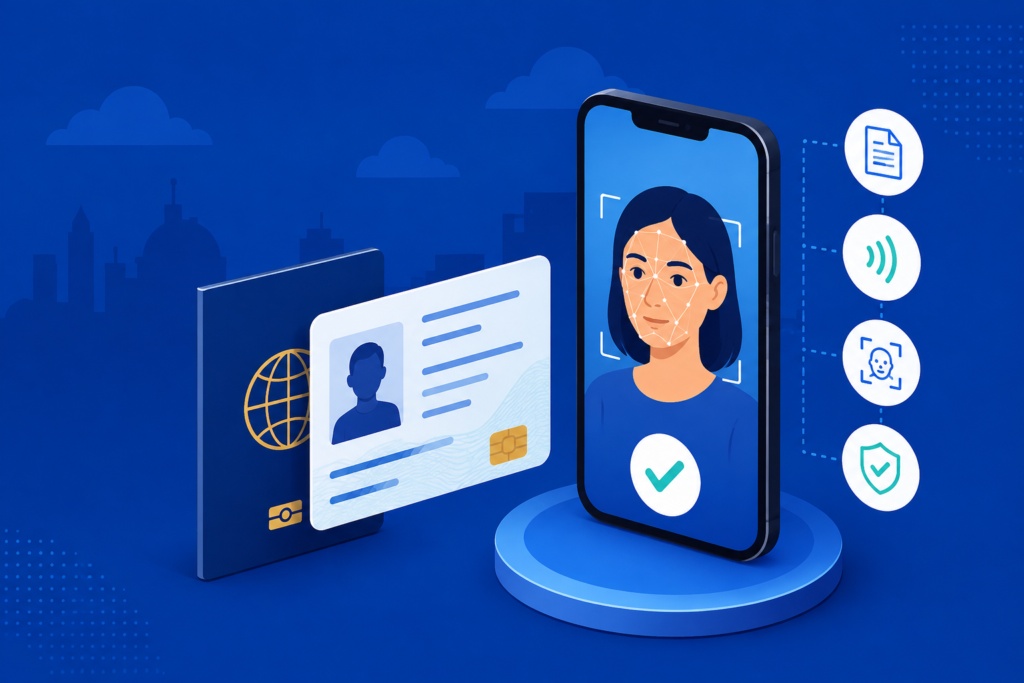
Traditionally, Know Your Customer (KYC) processes have relied heavily on physical documents, face-to-face interactions, manual checks, and lengthy verification procedures. These processes remain important for regulatory compliance, but they can create friction for customers and significant operational costs for organizations. Electronic Know Your Customer (eKYC) changes the experience by bringing identity verification into the digital journey. Customers can verify their identity remotely using technologies that capture and validate identity documents, compare biometric information, and check whether the presented identity is genuine. For banks, fintechs, telecommunications companies, insurers, governments, and other digital service providers, eKYC can make onboarding faster and more convenient—without compromising trust, security, or compliance.
1. From Manual KYC to Digital Verification Traditional KYC often requires customers to provide physical documents, visit a branch or office, and wait while information is manually reviewed. eKYC digitizes this process. A customer can capture an identity document using a smartphone or web interface. AI-powered technology can identify the document, assess image quality, extract relevant information, and perform consistency and authenticity checks. Depending on the identity document and verification journey, additional checks can include NFC chip reading, government database verification, and biometric matching. The result is a verification process that can be completed remotely, while giving organizations a structured way to establish confidence in a customer’s identity. The goal isn’t simply to remove paperwork. It’s to create a trusted digital identity verification process that works at the speed of digital business.
2. More Than Reading an ID Document A common misconception is that eKYC simply means scanning an identity document and extracting the name and ID number. In reality, effective identity verification involves multiple layers. Document capture and OCR can extract information from identity documents, including documents using different scripts and languages. Modern solutions can also assess image quality and identify issues such as glare, blur, or obstruction before continuing the verification process. NFC verification can provide an additional layer of assurance by reading cryptographically protected information from compatible identity documents and passports. This allows information from the chip to be compared with the visible information on the document. Biometric verification and liveness detection help establish that the person presenting the identity document is a real person and that their face corresponds to the identity being verified. Liveness technologies are specifically designed to help defend against presentation attacks such as photographs, videos, masks, and other forms of spoofing. Together, these technologies transform a simple document check into a multi-layered identity verification process.
3. Balancing Security With Customer Experience The challenge with digital verification is not simply making it secure. It is making it secure without making it frustrating. Every additional step in an onboarding journey can introduce friction. If customers struggle to capture their document, repeat verification attempts, or wait too long for approval, organizations risk abandonment. Modern eKYC therefore aims to make verification both rigorous and intuitive. AI can automatically guide document capture, assess image quality, extract information, and perform verification checks in the background. Biometric verification can add assurance without requiring customers to visit a branch or complete lengthy manual procedures. uqudo, for example, describes a verification journey combining AI document scanning, OCR, NFC, facial recognition and liveness detection, with support designed around the Middle East and Africa market. The best verification experience is one where security happens in the background while the customer experiences simplicity.
4. Why eKYC Matters for Africa For Africa’s rapidly expanding digital economy, the opportunity is particularly significant. Digital banking, fintech, telecommunications, insurance, e-commerce, and government services increasingly depend on the ability to establish trust remotely. But organizations must also deal with diverse identity documents, different languages, varying levels of connectivity, regulatory requirements, and the need to serve customers across multiple markets. This makes regional capability particularly important. Modern identity platforms are increasingly designed for the realities of the Middle East and Africa, including multilingual OCR, national identity documents, NFC-enabled IDs and passports, biometric verification, and integration with government identity databases where available. For organizations operating across Africa, eKYC can therefore become more than an onboarding tool. It can form part of the broader digital trust infrastructure needed to deliver secure, accessible digital services at scale.
From Verification to Digital Trust eKYC is ultimately about more than checking an ID document. It is about answering a fundamental question in a digital world: Can we trust that the person accessing this service is who they claim to be? By combining document intelligence, biometric verification, liveness detection, NFC, and other verification methods, organizations can establish that trust remotely while creating a faster and more convenient customer experience. As Africa’s digital economy continues to expand, the ability to establish trusted identities will become increasingly important—not only for financial services and commercial organizations, but also for governments building secure, citizen-centric digital services. At Datavera, we help organizations build the digital identity capabilities needed to create trusted, secure, and connected digital experiences across Africa.